Featured

Is Captain UK Irish?

Deep in the 80s, this possibility never occurred to me. The foreshadows of the Captain Britain Corps who turned up in the Alan Moore Captain Britain run – Linda McQuillan herself, Captain England, Captain Albion – suggest that the sheer multitude of Captains just riff on the CB identity with minimal fuss. We’re just meant to see the terms Britain and the UK as interchangeable, right? So CB and CUK are mirror identities, they map neatly onto one another.

But Britain is not altogether the UK. Britain is the landmass comprising England, Scotland and Wales; the United Kingdom is the political entity comprising England, Scotland, Wales and Northern Ireland. And it occurs to me that reading Captain Britain in the 80s in Northern Ireland might have been a very strange thing to do.

If Chris Claremont had been writing CB in the 80s, we wouldn’t be having this conversation. If there’s one thing Chris knows, it’s that an accent can do a lot of heavy lifting. In fact, in the right hands, an accent can do at least 60 per cent of your characterization, nein, katzchen? So if Claremont had been the writer, and he’d wanted to make CUK (Northern) Irish, he’d have dialled it up to maximum Banshee, and we wouldn’t have any doubts.

Moore and Delano? No such luck.

Instead, all we have is a coincidence: the surname McQuillan, which Wikipedia tells me, is not only Irish but that Mc (not Mac) is the “Ulster variant.”

Even if we’re not playing the Claremont accent game – even if we don’t hear Linda speak with a Northern Irish accent, we can certainly say that she is of Northern Irish parentage, or ancestry.

Does this do anything to our experience of the character?

Linda McQuillan first appears in the Alan Moore stories of the 80s. Who, either born in Northern Ireland or with their roots there, would wrap themselves in a Union Jack? How could it be seen as anything other than the most appalling provocation? How could you not associate that flag in Northern Ireland with political dispossession, the corrupt RUC, the loyalist paramilitaries, the free hand of the British security forces?

Unless, as one of the interviewees in James Bluemel’s extraordinary documentary series Once Upon a Time in Northern Ireland says, if you’re a Northern Irish protestant, you’re “more British than the British.” Is that we should think? Linda’s on the side of the security forces, the loyalist paramilitaries …? Or does she put on the flag because (cf. Captain Britain, in his Paul Cornell incarnation), she “wants to represent, like Steve Rogers did” – and somehow thinks, in a haze of naivete, that the Union Jack can represent both communities at once …? Is she somehow a bit like Sean Duffy, the Catholic cop in the RUC, in Adrian McKinty’s crime series?

You can see how unfathomable and even absurd all this is. The absurdity is baked into Dave Thorpe’s abortive plan to “tackle” Northern Ireland in the early days of the revived CB. This plan was famously terminated with prejudice by Bernie Jaye, and in its place came the fantastically weak allegory, if it was even that, of the Rottenpasts and Coalitch. But imaging Captain UK as herself Irish shows just how crass Thorpe’s original question was: to ask, as he recalls doing, “What would Captain Britain have to say about the Northern Irish question” is to give CB the luxury of considering this tortuous, murderous legacy of colonialism as, precisely, a “question” – it’s only a question if you don’t have skin in the game. It’s a “question” if you’re quaffing brandy with the chaps at the club, and the real consequences of this legacy never come anywhere near you.

More to come, you lucky bastards.
Featured

Press Gang Rewatch: The Last Word

A tic in pop criticism that I find aggravating is when a writer says that Show X or Book Y “deals with the topic of …” This promises that Show X or Book Y proceeds somehow from an analysis of the topic; that the topic is not just a Thing in the Story. But the writer of this kind of criticism almost never actually explains why the topic is “dealt with” rather than merely being the occasion of the story. Hence the Wikipedia page for Press Gang, which tells us that the show “tackles” the topic of “firearms control.”

Does it, though? Really?

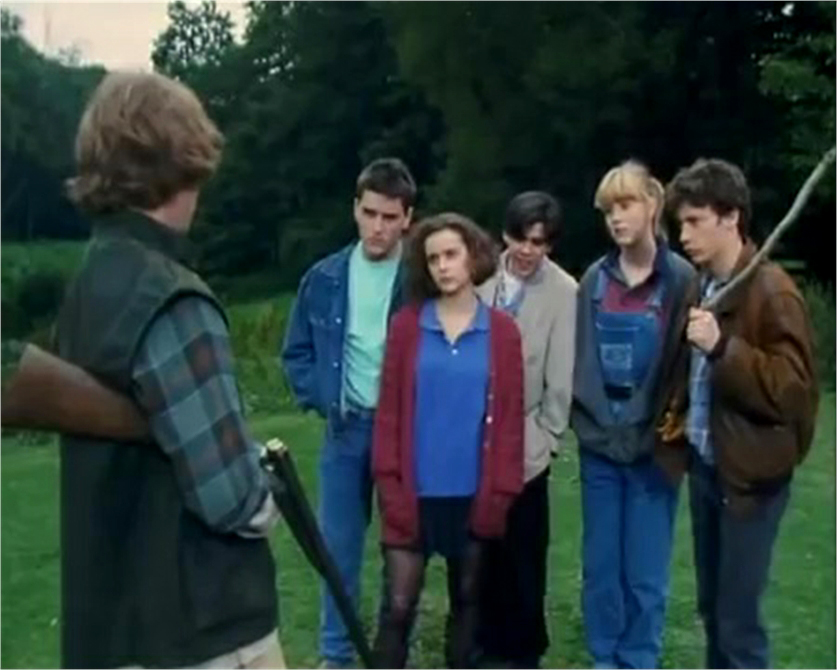
Make no mistake: The Last Word Parts 1 and 2 is solid gold, high watermark Press Gang. Everyone is firing on all cylinders here. Moffat is at his craftiest, using two frame narratives (one per episode) to show that a Junior Gazette staffer has died in the siege – and giving us two shots fired, to make us think that first Colin and then Spike may have died. The get-out is tremendous – of course Lynda will follow through on her promise, even though Donald Cooper is dead. And of course she is thinking it through, putting the plan in place, even though Spike has just witnessed his death and is freaking the math out. Her word is absolute. Which sometimes makes her a tyrant; but also sometimes makes her incredibly decent and humane – as when she tells David Jefford, after his blackmail attempt, that he is welcome back on the Junior Gazette, she will forget the blackmail attempt ever happened. (Counter-reading: Lynda is at her steeliest, and she has more chance of beating the odds if David thinks he can come back.)

But is any of this “tackling” the issue of firearms control? Better: was firearms control any kind of issue in the UK in the early 90s? A few years after this episode, the UK’s only school shooting took place in Dunblane, and the (Conservative) government’s totally uncontroversial response was to ban handguns. Rather than saying this episode “tackled” an issue, we might be better off seeing a pattern: that in Press Gang, there are only two episodes (I think) in which guns are used as part of the narrative. In both instances they are fired by lonely boys who seem to have problems with their families (Donald Cooper says that his mother might notice him, as a result of the siege). And crucially, the guns are used for suicide. If anything, even two instances of this pattern seems like quite a high incidence of gun suicide among teenagers for Lynda and the gang to encounter; if anything, this pattern seems to be telling us that you may never be standing far away from someone who is far more desperate than they appear.

Featured

Press Gang Rewatch: Monday Tuesday

Let’s start thinking about Press Gang – still, for my money, Steven Moffat’s most sustained, serious work – by looking at two instances of jokes that are not jokes. These are instances of dialogue that have the rhythm of a joke, but are not the emotional content of a joke. To be more precise – jokes can be complicated and transmit a range of feelings, but generally still make you laugh. The two parajokes I’m looking at here shock you by using the rhythm of the one-liner to do things that aren’t funny. Or are too strange, too uncomfortable, too serious to be only funny.

Both examples are from Monday Tuesday, the penultimate episode of season 1.

The first is a punchline Linda delivers – incredibly, this is how we learn that David Jefford has committed suicide:

COLIN: What kind of a crazy kid puts a loaded shotgun in his mouth? Was it loaded?

LINDA: Not after he pulled the trigger.

It’s worth repeating: we know before this that something very bad has happened – but this punchline is how we find out that David Jefford is dead. It’s wordplay; it’s clever; it makes you want to laugh, to marvel at the quick-wittedness of the writing; and at the same time, there is something horrifying about this narrative turn coming through the device of a punchline.

There’s a similar moment in one of the episode’s final bits of dialogue. The narrative track cuts back to Monday, the day of the suicide, and we find Linda and the news team confronting David, telling him that they won’t give in to his blackmail, and that he is an all-round nasty piece of work. They meet him on his father’s estate, and he is carrying a shotgun, to shoot rats, he says. As the team walk away, we hear a gunshot, off-camera, and Spike comments, “He must have bagged a rat.”

At this point in the episode, we know David is dead. I don’t think we’re meant to assume that David shot himself immediately after the confrontation; but the sound of the gunshot materializes his death. It may not be the sound of his death; but it is the same sound as his death. It is the closest the episode gets to depicting it. Which makes Spike’s comment – the second punchline I’m talking about here – all the more horrible. At the sound of the gunshot, Spike quips, “Sounds like he bagged a rat.” And because we, the viewers, occupy a different perspective – we know David is dead, in narrative time – it sounds as though Spike is calling David a rat, even though Spike cannot be doing this, because he can’t know that David, at some point between Monday and Tuesday, will turn the gun on himself.

Unlike us, Spike doesn’t know that David will die later in the episode’s chronological time; so this remark is horrible for us, but not for the characters. Again, the rhythm of the joke creates a moment in the episode where several contradictory feelings come through all at once. We can’t condemn Spike for this callous joke because it is callous for us and not for him. But we are nonetheless expected to recoil, to feel horror at this bit of wordplay, which can only mean, really, to feel horror at Moffat himself for writing this quip, for making us feel exactly what we feel here.

Timothy Clarke, in Ecocriticism on the Edge, comments on the capacity of criticism, thought, philosophy to seek connections and patterns and in so doing make things smooth, intelligible through patterning and pattern seeking. And by doing this we might miss things; sometimes discjuncture might be more important. So I hazard the next observation a bit cautiously:

Monday Tuesday, if I remember this right, is Moffat’s first experiment with narrative time, with reordering the chronological sequence of a story for (let’s say) aesthetic effect. What I want to suggest here is that these two jokes, or parajokes, are a smaller, sentence-level instance of the same impulse. Just as the episode’s structure aestheticises a disruption of narrative expectations, these two parajokes interrupt our expectation of the structure of a joke (ie, that it should make us laugh – rather than gasp, or recoil, or freeze).

Too neat, no? That’s what the pattern-making urge does. We can say there are echoes here, between the micro and macro. But I don’t think that Moffat planned it – a first time writer, 25 years old, cranking out twelve scripts per season? I don’t think you have the bandwidth for it. But I’m a death of the author guy from way back – does it matter what Moff intended?

I suppose there are different ways of attending to the “truth” of artistic production at 4:45 on Children’s ITV, in the deepest heart of 1989. Part of that is to say that death of the author gets you one version of the events (an intricate, echo-woven experience). But the other is important too – as I said earlier, I still think Press Gang is Moffat’s most serious work, and these jokes are part of that. It doesn’t matter whether they echo other elements of the episode – they are the work of a writer of such seriousness, such intent, that when depicting the suicide of a teenager he bends even the structure of his jokes to reflect the horror, to put the viewer in the position of “What do I do with this? How do I react?”  

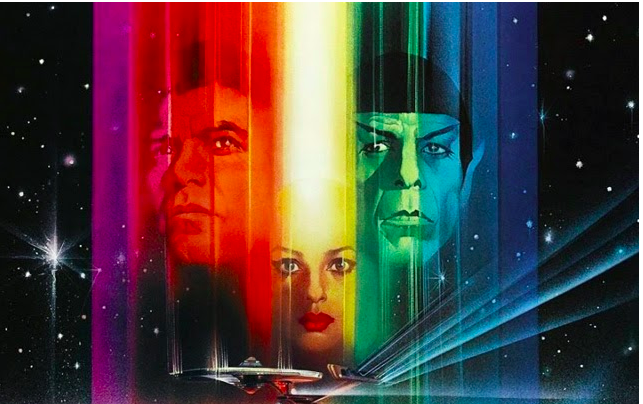
Star Trek: The Motion Picture

We were talking before about one of The Shat’s typically strange choices in this flim, but I’d like to think about TMP a bit more generally now.

What a weird film TMP is! Even in 1979, who used the phrase “motion picture” anymore? – The grandeur! Sometimes I wonder if this is even Star Trek, strictly speaking – even though it seems to have been commissioned in response to the success of Star Wars, Roddenberry’s real inspiration is 2001. TMP, in its slowness, its ponderousness, wants to say, “Look how serious Star Trek is! Look how serious I, Roddenberry, am! Look upon my works ye mighty and despair, HA HA HA!”

But 2001 is really a kind of visual poem, and Star Trek was always space opera (or space navy), so the glueing of one form onto the other is uneasy, not least because an essential part of Star Trek is its Faith in Humanity. The trippiness of 2001 is a code for evolution – it challenges you to make sense of it because the being for whom it is all obvious – the being for whom it would be space opera – is whoever comes after humanity in its present form. You think something like that is going to happen on Gene’s watch?

TMP ends with a kind of pulpy depiction of evolution and then comes crashing back to earth – yes, earth. It might look like Decker/V’ger/ilia are/is evolving into something new, a new life or new civilization, but really, this is the most appalling thing Gene can think of. So Kirk immediately neutralizes the concept: the threeway entity of V’ger, Decker and Ilia (there’s nothing wrong with that – this is a sex positive blog) has gained, says Kirk, the human ability to create its own purpose. Of course! It was humanity that was missing all along!

And there, spread across the screen as the titles roll, is Gene’s proud proclamation of his failure to learn from 2001: “The human adventure is just beginning.” So yes, this is Star Trek through and through – and when I try to imagine this strange, fascinating, entertaining failure without Kirk and the gang – with some other crew, knocked together just for this epic – I can’t, of course. Even though it feels like they don’t altogether belong in Gene’s Philosophical Epic. Do I resent it for this? I do not. Just as I am not bored by the slowness of its pace. I love the slowness, because I get to spend more time with these guys; and TMP has a strange kind of depth to it. Some fans like it because it is “philosophical” Trek, i.e. Trek at its highest state of being, its purest form. To that, I say Hmmmm. This film shows that Roddenberry as philosopher is a bust. But this is, nonetheless, a mind trying to work with problems that are beyond it, and this gives the film, I think, a real seriousness. The endgames are trite; but the seriousness and depth comes from the struggle.

Did Captain Britain vote for Brexit?

Well? Did he? We’ve all been wondering since 2016, haven’t we?

Let’s review the evidence.

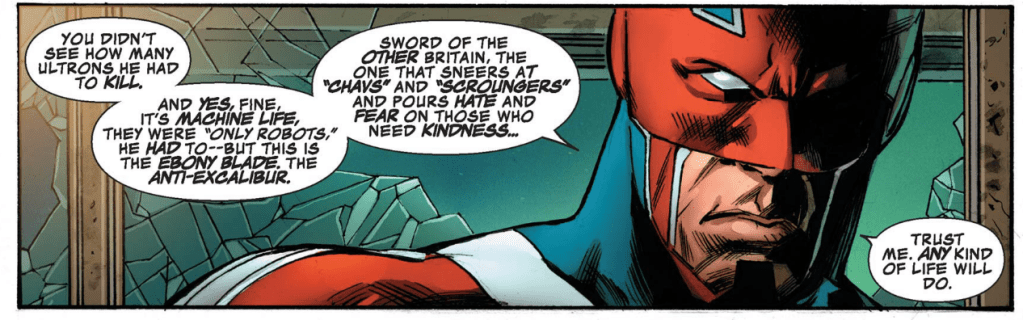
This guy – I’m not sure this guy even votes. Voting is beneath him. Voting is for the small folk, buffeted by the vagaries of destiny, sustained democracy’s necessary illusions, the pretence that just occasionally, just for the blink of an eye, their lives are not flailing entirely out of control. But this guy – he knows that real power is exercised elsewhere. England expects, gentlemen.

This guy? It could go either way. Maybe, out of some misguided sense of identification with a populist cause, he might just vote for it. He’s been out of touch too long, he’s forgotten his responsibilities. This Brexit business is making a lot of noise. Farage says it’s a revolution for the little people. OK. Maybe I should get behind this.

And this guy? Well, of course not. And that would go double for the Captain written by Paul Cornell too. Cornell’s incarnation of Captain Britain redrew his powers so that they waxed and waned with his confidence. A populist mission like Brexit is based on the idea that national power never wanes, unless constrained by the EUSSR (some people actually use that expression). So the Cornell version can be read as an attempt to reconcile being a flag-wearing hero with the idea that a national power is limited (in all sorts of ways – diplomatic, economic, conceptual, ideological. At a conceptual level: to revere one’s nationhood above all things limits you – a necessary and powerful thing for Brian Braddock to represent, from the glamour of his flag).

Now, is there a serious point to be made here, or am I just being even more whimsical than usual? How about this – Voter (or non-voter) no. 1 above comes to us from a Jamie Delano script, and I think that Delano very much takes his cue from the Moore incarnation – that is, an absurd, flag-waving muscle-bound clown with a brain the size of a pea. (I’m paraphrasing Moore a bit here – and I don’t think he ever, in practice, wrote the Captain quite that ludicrously). I wonder if both Moore and Delano couldn’t help but feel ambivalent, at that point in the 80s, about a character wrapped in the Union Jack. The Union Jack was what the Conservative party chose to wrap themselves in too; and the National Front; and in the wake of the Falklands war, had uncomfortable military associations too. The British left has always had a tough time working out how to reconcile internationalist sentiment, popular appeal and national symbols (it has almost never succeeded). So is it any wonder that the Captain was often in this period something of a twit?

The versions written by Ewing (all too briefly) and Cornell (yes, all to briefly too) come after two significant cultural points: the signing of the Maastricht treaty that transformed the European Community into the European Union (1993) and the Cool Britannia period of the mid-90s, during which it felt that an outpouring of art (Damien Hirst, Trainspotting, Britpop) was matched by the resurgence of a now-unstoppable Labour party. Noel Gallagher’s Union Jack guitar, Geri Halliwell’s Union Jack dress. These artefacts harked back to mod aesthetics, of course, so much of a potential nationalist sting was taken out because they felt retro. But something else has happened: being a member of the EU helped with that reconciliation of patriotism and internationalism. The Union Jack was one among many other EU flags, and and the EU had a flag of its own, to boot. National symbols could be symbols of joining, of belonging to a larger community – a way of saying “Yes, we are here too, we also participate.”

What this means is that Cornell and Ewing come to the character when no-one doubts the UK’s future as part of Europe. And there is no need to feel weird or awkward about a character wearing a flag, because that flag is now a symbol of belonging.

So in a way, voters 1 and 2 here dream of becoming voter 3 – a character who can be written sincerely, passionately, open-heartedly, someone who speaks of a nation as belonging and caring.

Next question: Is Captain UK really Irish? (I’m serious; tune in next time, kids.)

Frank Miller Writes Daredevil

Two panels drawn by the incomparable Mazzucchelli this time. But it’s Miller I want to talk about here. Sometimes I wonder if the reason Miller has become so hard to talk about is because he started to believe that the noir tropes he loves so much are actually real life. Noir undoubtedly made Miller the writer he is; the noir sensibility makes his work distinctive. But maybe if you’re eye-deep in that world for your work, you start to think that life is noir … and then where do you go? Well, self-parody is one option. But his recent Superman story is meant to be good, I think? Is it?

Anyway, let’s talk about the artistry here. I want to spend some time with Born Again – it’s a story I love, and it’s worth dwelling on; there is stuff to learn about and revel in, across a whole spectrum of reading modes (genre stuff, medium-expanding stuff, cultural materialist perspectives, &c., &c.). But small scale artistry to start, blink and you’ll miss them moments:

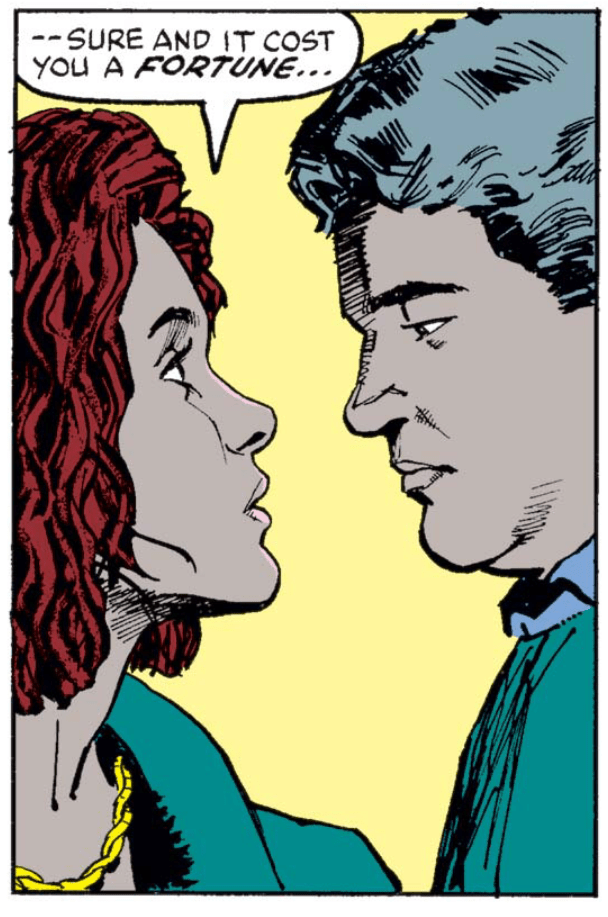
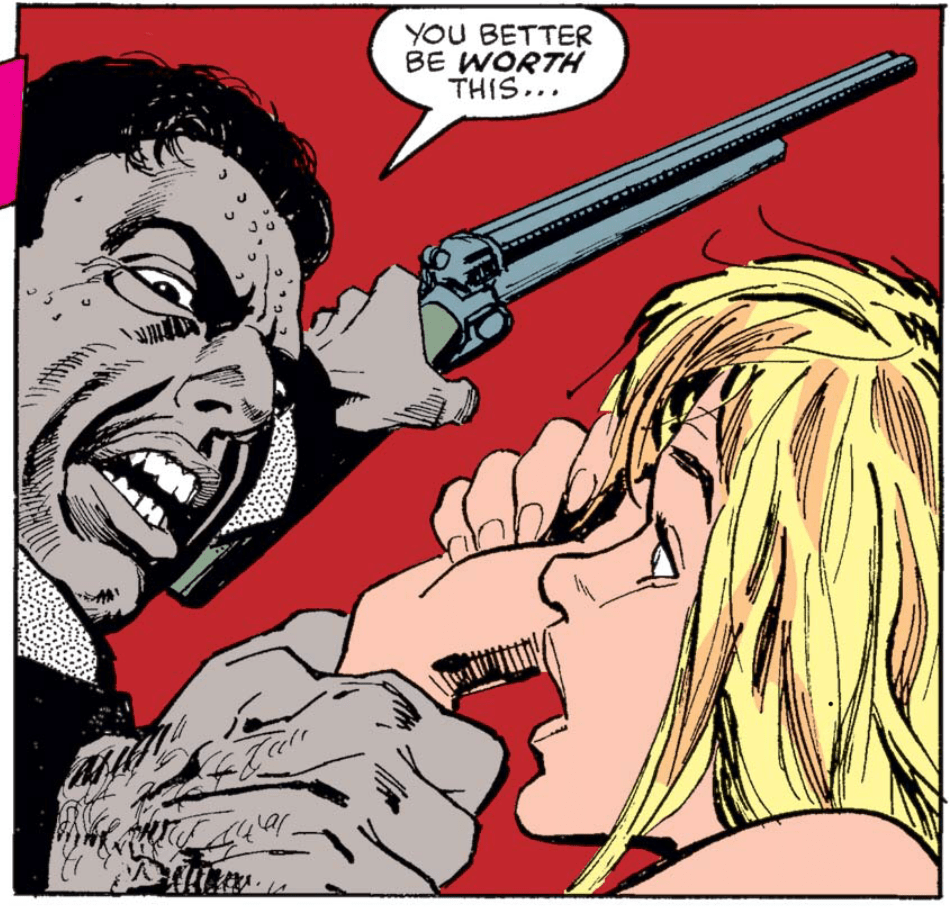
So here we are, in two of the subplots that are interleaved with the story of Murdock versus the Kingpin. In the copy I have (the 1987 Marvel trade paperback – yes, I’m that old skool), these occupy the same space on facing pages, ie the bottom left panel on each page. No idea if it was like this in the individual issues (I have these as well, but they are at my dad’s house in a whole other country) – but who’s to say that the individual issues are the most authentic way to look at it? The 87 TP gives us this visual echo even if the issue doesn’t. The point being: Miller uses the language of value/transactions/worth to make these two scenes counterpoint each other. For Karen, we are at another nadir in a series of nadirs – Paolo kills the Kingpin’s hitmen, but it is quite clear that his payment for a ride to the States is going to be sex, and Karen “had better be worth” it.

(Paolo is very useful for Miller to move plot – he never hesitates to open up with the shotgun, and a couple of issues later kills two cops when it would have been vastly more sensible to hightail it and let discretion be the better part of valour for now.)

For Foggy and Karen, on the other hand, everything is coming up roses – or maybe pearls, or diamonds, or rubies – I dunno, but it must have cost Foggy a fortune. Foggy and Glori have been getting closer and closer over the last few issues, and Foggy’s Christmas present allows the two of them to see how important they have become to each other.

The language of value, transactions, exchange – “worth this” – “cost you a fortune” – and the positioning of each panel at the same place on their respective pages – allows Miller to counterpoint the vastly different fortunes of the subplots’ protagonists.

(There is more to say about this – not least about visual media – not just comics – using “spending a fortune” as a shorthand to depict a male character’s feelings for a female character, and, crucially, the reciprocation of those feelings. But that’s something I’ll get into in another post.)

Mazzucchelli draws Batman

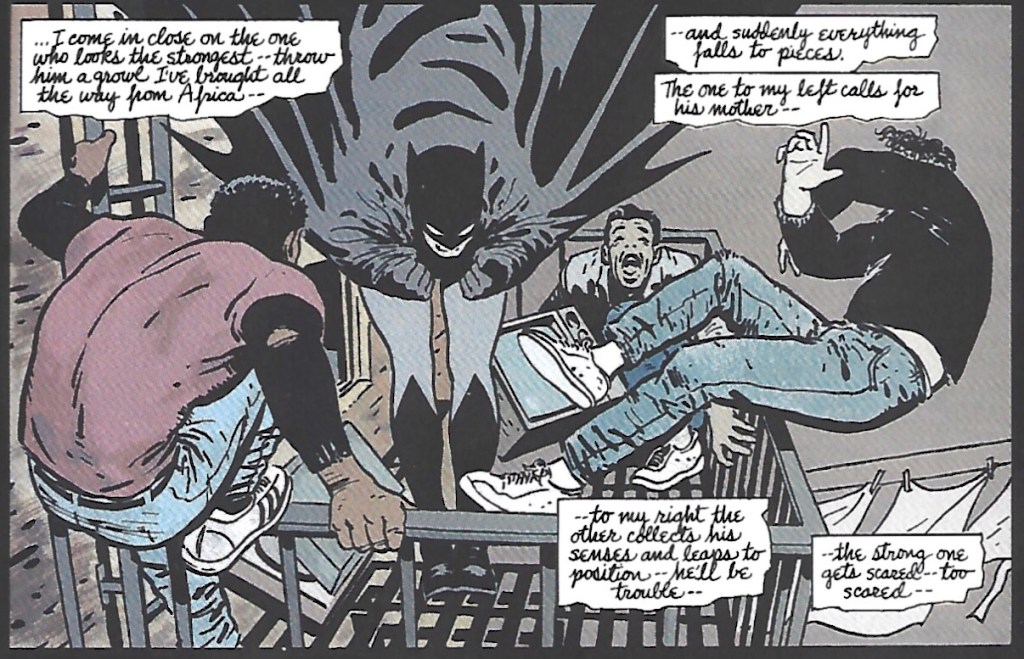
A few short notes on the brilliance of David Mazzucchelli, based on the extraordinary kinetic energy of this panel.

A single panel arrests, freezes, a single moment, or perhaps two or three – depending on how many speech bubbles there are. No speech here – although we might take Batman’s narration to spread the action here over a second or a second and a half.

But let’s think about the way Mazzucchelli distributes action over space.

First, the element most easily missed – the perspective created by the lines denoting brickwork and the bars of the balcony floor. These align the reader’s eye with a vanishing point somewhere behind the panel. This is the first movement of the reader’s eye and mind.

The second, and clearest: the downward motion of line, eye and mind. All in parallel: The vertical fencing of the balcony, the ladder at the left of the panel, and Batman, drawn with his cloak flying behind him so that he bisects the panel.

This already sounds busy – the reader’s eye is working on two planes. But here’s the really clever thing:

There is a line of motion, left to right, across the panel, making a third plane that the eye moves along.

At the far left: the thief ready to spring into action. He’s hoisting himself onto the balcony, so that his motion reverses Batman’s, mirrors it inversely. Then: Batman himself, landing right in the middle of the panel. And then, right: the third thief in motion, falling backwards. His line of motion is on the same plane as the first thief’s, so Batman splits that plane with his arrival. The amount of kinetic energy in the panel increases as we move left to right across the panel. Even the washing line at the bottom right contributes to this effect.

Also worth noticing – the textures. No costume detailing, no exaggerated muscles in his legs; heavy black for the the boots and cowl; splashes of black to indicate folds in the cape. Compare it with the gritty, rugged denim of the thieves’ jeans.

Rereading Mark Gruenwald’s Squadron Supreme: 4. Shoot them with the bop gun

When Nighthawk says he is going to legalise guns again, what kind of guns is he talking about?

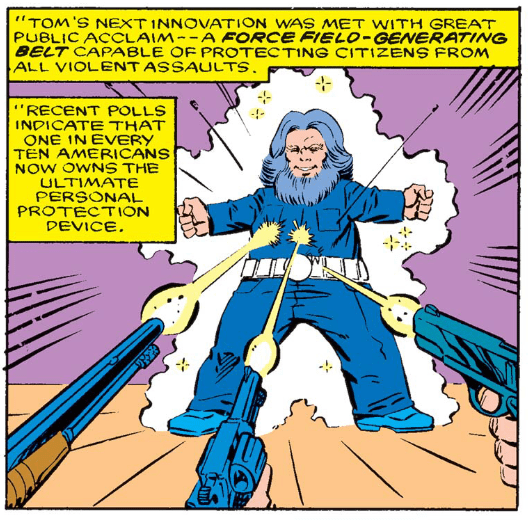
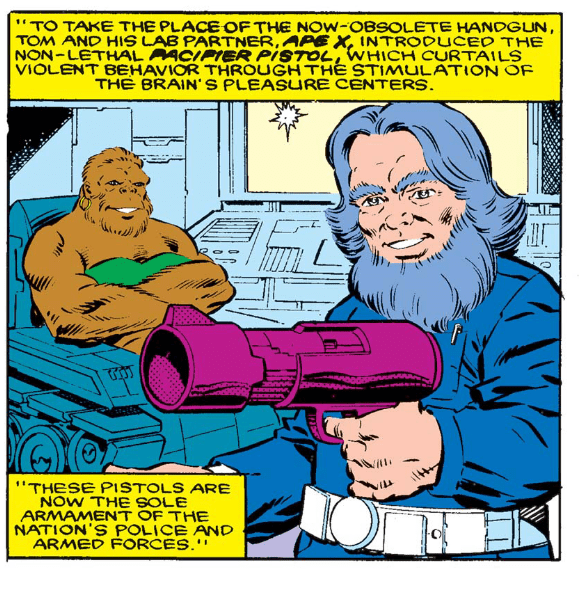
We know that the police are now packing pacifier pistols (I alliterate to channel the spirit of Smilin’ Stan), which incapacitate by flooding the target with positive vibes. Now, when you think that Watchmen and Dark Knight are charging down the track towards us, at the time of publication, this is about the least 80s thing anyone could have come up with. Overcoming criminals with the power of pleasure! Wrangling wrongdoers with beams of bliss! Purveying a penalty of pleasure not punishment! It’s not very grimdark, is it? Not very “realistic” – and we are about to decide, at this point in the 80s, that we like our superheroes “realistic.”

Again, this is about releasing the reader from the Squadron’s world.

How could anyone – even Nighthawk – possibly think that giving people back firearms is a good idea? Unless what he means is, anyone can legally buy a pacifier pistol? Well, maybe. But that’s not really the thrust of what he’s saying. He wants to roll back everything the Squadron did – not everything “except those pacifier pistols, we’ll have those.”

Nighthawk’s tragedy is that he is an absolutist – and the problem with this kind of absolutism is the inability to see absolutes as historically contingent. That is, what seems utterly essential at point A in history may seem wholly bizarre at point B in history. A world in which firearms have gone – and pacifier pistols have appeared – can only be a good one, but this is a calculation Nighthawk cannot make.

Nighthawk is seeking a kind of narrative status quo ante. The clue is in the name – the Squadron’s Utopia Project. A place that is not, that cannot be. Two worlds are about to merge – that of the Squadron, and that of the reader. By rejecting the blissed out promise of the pacifier pistols – violence that is not violence, that literally replaces violence with bliss – Nighthawk moves the Squadron’s world back towards ours. You are leaving Utopia now, says Nighthawk to the reader. Even before you close the comic, your world has come back.

Star Trek and Family

One – possibly both – of these men is not really Scottish

The idea of a starship crew being a kind of family seems absolutely essential to Star Trek, locked in – you can’t think about Star Trek without it.

In Voyager, Janeway makes it explicit – on more than one occasion, she tells us that “this family” is not going to be broken up by whatever forces menace our pals that week. And Discovery, I think, tries to think through the implications of a (quasi – or maybe wholly) military hierarchy being a family (something for a later post).

But where does the idea come from? Was the Enterprise crew (the original gang) always a family? Surely not, right?

I think you can date it right back not just to The Motion Picture, but to one of William Shatner’s characteristically unusual choices.

(Generally I like The Shat. I like his unusual choices. I like the evolving Kirk, even as, by the time we get to what we might call Shatner’s late style – V through Generations – a kind of knowingness begins to insinuate itself into the performance. It’s a note that could easily be mistaken for self-parody, but I think it’s something more nuanced, strange and gentle. I’m not yet quite sure what to call it.)

The things that catch my attention – things I like to write about here – are often details of text that I haven’t noticed on a first (or fifth, or whatever) reading, but when noticed, seem inexplicable to me. Here, it is Kirk adopting a Scottish accent. “They gave her back to me Scotty,” says Kirk. Scotty says he doubts it was that easy; and Kirk, inexplicably putting on a Scottish accent, says, “Ye’re right.”

What on earth?

What was Shatner thinking? What is this meant to signify? Has Kirk ever imitated accents or voices before? I have many friends who speak with many different accents, dialects, idiolects – the idea that I would suddenly, in the course of our everyday conversation, lapse into one of those accents is bonkers. They would look at me like I had gone mad.

We were talking before about Barthes and S/Z, the codes that structure acts of reading and interpretation. The hermeneutic code, for Barthes, structures enigmas within a text that may or may not be solved. Not so much the mystery of the detective story (which is plot – the proairetic code), as the mysteries that cluster around the mystery, especially when there are many possible answers (Why does Macbeth murder Duncan?).

So when we hit an uninterpretable nugget like this, I reach for the hermeneutic code. But: this code deploys itself when the text is interested in the mystery it opens. The central hermeneutic code for Star Trek: The Motion Picture contains all the questions around whether humans can evolve and remain humans – in other words, the code gives us things that are consequential. But this weird bit of accent play? This means almost nothing. It is in the text, but the text is not interested in it. Nothing structural, thematic or narrative comes from it. It is like rhythm, per se – that is, when we learn poetry criticism at school, we often say that a certain rhythm creates a certain feeling, which we then argue is keyed to a theme, concept or metaphor. But rhythm  per se means nothing – the thematic reading that we do in school recuperates a  physical phenomenon (of the mouth, tongue, teeth – “where breath most breathes”) that is a kind of abyss-like pleasure: rhythm pleases, but for no reason accessible to consciousness, and it does this pleasure-work utterly separately to any thematic meaning we may wish to impose on it. (I think Kristeva calls these elements of a text – that are independent of meaning – the semiotic.)

So there is something of a non-signifying rhythm or semiotic about Shatner’s weird accent choice. The difference here is that I’m not sure it’s pleasurable. It’s just too odd – and brief – to be anything other than a kind of stumbling block, a snag in the text that the mind gets caught on. (Perhaps this is also an instance of what Derrida calls the “true secret” of literature – the text can never say more than it says. We can interpret away, but we cannot know why Macbeth killed Duncan.)

I digress. (Sorry.)

Let’s put this moment back in context. Off we go to the Enterprise, Kirk imitates Scotty’s accent; they chuckle in recognition of that fact that Nogura certainly did not give Kirk back the Enterprise at the drop of a hat; Scotty affectionately squeezes his arm. Now, even if you have not just spent 600 odd words wondering why The Shat affects a Scottish accent for precisely two words out of the entire canon of Star Trek, you might also think: Whoaa – Kirk’s an admiral! He is Scotty’s superior officer! How come they’re so pallsy-wallsy?

Well, because they belong to a family-like structure, right? But: was that there in the TV show? Kirk and Spock have this great friendship of course, and the Kirk-Spock-McCoy triumvirate has always had a kind of mythic power to it. But I don’t think there’s anything in the original series that insists we think of the command structure as anything but a command structure.

In other words, I wonder if this moment is the first time we get a sense of these guys as family.

Which means that Star Trek had to go away and come back in order for it to feel like this. Kirk’s awe, an experience of something like the sublime, at seeing the Enterprise again plays out the audience’s feelings at having been away from Star Trek for a decade: the pleasure of saying, “we’re back.” The time apart (our time away from them, the actors’ time away from the show) helps to reconfigure this group as a family. We have been longing to see them – there must be a way to register this on screen. The way to do it is to show that they are people who can show affection to one another, regardless of rank. This crucial part of Star Trek, then, is in part an effect of something off-screen. Something real is in the text.

Rereading Mark Gruenwald’s Squadron Supreme: 3. S/S

Maybe – or maybe it’s just me – looking at the loading of all these layers across a couple of pages has put you in mind of Barthes’ S/Z. It has, hasn’t it! Go on, you can admit it!

Barthes, in S/Z, devises a series of codes that underpin the interpretation – the act of reading itself – of Balzac’s “Sarrasine.” Some of them transfer easily enough onto the different layers of text we talked about in the previous post: for the narrative action, Barthes gives us the proairetic code. The associations called to mind by the text are mapped by the semic code. The cultural knowledge we share with the text is described by the cultural code – and so on. (And this cultural code is something I would like to discuss in a future post – in part because there are so many assumptions the text seems to make that I don’t share, but also because I think reading it as a cold war artefact helps us understand it better.)

But for now, I’d like to invoke a code that only applies to certain comics being written in the 80s. I’ll call it the Ghost Code for now, because I’m not yet quite sure if it is a property of the text or not. This code structures our reading when we deal with a text that seems to press at the boudaries of what superhero comics in the 80s could do, without any desire to blow apart, dissolve or transcend those limits (in the way Alan Moore would do, for example).

One of the things that makes Squadron Supreme compelling is that it is, in one way, an attempt to write the very last superhero story. What other endgame for the genre other than the creation of utopia on earth? If great power confers great responsibility – well, have we got some responsibilities for you! So this would be a proper twilight of the idols, the final world-saving act in the Squadron’s lifetime of world-saving. It is apocalyptic, because it is the end – the genre can go no further – and because it reveals something we already knew, the profound truth of these atomic women and men in their dazzling outlandish garb. We always knew this was their destiny.

Or so it might be – if Gru was not committed to thrills in the Mighty Marvel Manner, because you demanded it, true believer. The ghost code is what marks our reading when a story like Squadron Supreme seems about to transcend itself, when the narrative is on the verge of demanding a different treatment, different narrative choices and a different form. Those moments where the narrative seems on the verge of such novelty that it must surely be about to become – who knows? Watchmen? V for Vendetta? From Hell? Moments where the narrative demands that the four colour funny book changes into something very different, renews itself, reinvents itself, becomes a new form – and then refuses to cross that line. But the reader knows that the line is there, is close – and this itself produces a moment of immense pleasure. The ghost code is still a pleasure code.